





When it comes to cordless telephony in the workplace, DECT is often the first technology that comes to mind. But did you know you can also carry voice over Wi-Fi networks?
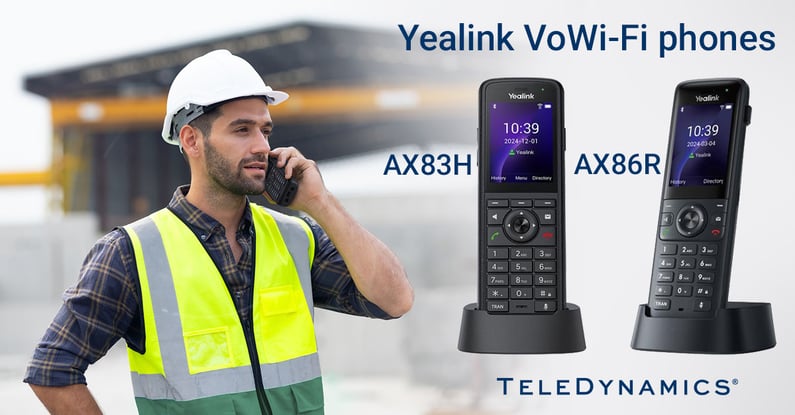
Yealink's AX83H and AX86R Wi-Fi phones make a compelling case for this approach. Both deliver enterprise-grade voice capabilities and seamless mobility over Wi-Fi.
In this article, we explore how Wi-Fi compares with DECT and Bluetooth for cordless telephony, then take a closer look at the AX83H and AX86R, comparing their features, capabilities, and ideal use cases to help you determine which is the better fit for your customers.
Voice over Wi-Fi: Benefits and network requirements
Most enterprises already have a fully functional Wi-Fi network that covers most areas of their premises. This makes using Wi-Fi phones a smart choice because they leverage existing infrastructure without requiring dedicated base stations to support telephony services. Wi-Fi phones connect to the existing Wi-Fi network and register to a local or cloud-based IP PBX, typically using SIP.
Wi-Fi, as a technology, provides the necessary mechanisms to ensure that voice services enjoy the same quality we have come to expect from the telephone. Wi-Fi has mobility and handoff mechanisms that allow devices to transition between access points during an active call, along with quality-of-service features that help maintain a good user experience.
However, just like everything else in life, you can’t get something for nothing. A key requirement for reliable voice services over Wi-Fi is that the network be properly set up. Although the technology is more than capable of supporting excellent voice services, the appropriate QoS policies, adequate wireless coverage, interference management, and roaming support must all be in place. Ultimately, while Wi-Fi telephony offers ease of integration and flexibility, reliable voice communication over Wi-Fi requires a well-designed wireless network.
Voice over Wi-Fi is not limited to any particular Wi-Fi generation; it can be deployed over existing Wi-Fi networks, including those using older standards such as Wi-Fi 4 and Wi-Fi 5, provided they meet the requirements for reliable voice communications. However, Wi-Fi 6 offers additional advantages, particularly in high-density environments. Defined by the IEEE 802.11ax standard, Wi-Fi 6 improves wireless efficiency and performance when many devices compete for network resources. Technologies such as OFDMA and BSS coloring help reduce contention and improve spectrum utilization, potentially reducing latency and jitter. These improvements are especially beneficial for voice traffic, where timely and consistent packet delivery matters far more than raw throughput.
Voice over Wi-Fi vs. DECT vs. Bluetooth
But why Wi-Fi? Aren’t DECT or Bluetooth better? Well, these technologies are not necessarily direct competitors to Wi-Fi for voice. DECT is a purpose-built cordless telephony technology that requires dedicated base stations, offering performance without sharing the same infrastructure with other traffic. Bluetooth, on the other hand, primarily provides short-range connectivity between headsets and other devices.
Wi-Fi, however, allows a portable IP phone to connect through an organization’s wireless LAN infrastructure, potentially offering extensive coverage, SIP integration, and mobility between access points. So, the choice of technology depends upon infrastructure, coverage requirements, operating conditions, and mobility needs.
Yealink AX83H and AX86R: design and hardware
Yealink’s Wi-Fi phone offerings provide two options that cover a wide range of business needs. The AX83H Wi-Fi phone has a lightweight, portable design weighing just 4 oz (126 g), a comfortably large color screen, up to 9 hours of talk time, and up to 200 hours of standby time.
The device supports Wi-Fi 6 and IEEE 802.11k/v/r roaming for seamless transitions between WAPs as it moves throughout the coverage area. The phone can be connected to a headset via Bluetooth or via a 3.5mm audio jack. HD audio and Smart Noise Filtering Technology allow fluent conversations with little distraction. Easy USB Type-C charging is available, with wall-mountable, stand-mountable, and belt-clip accessories.
The AX86R ruggedized Wi-Fi phone goes a step further by providing a ruggedized device rated IP67 for water and dust resistance while being drop-proof from a height of 6 feet (1.8 m). It has many features of the AX83H, but with 13 hours of talk time and 300 hours of standby time. Its casing has an antibacterial design and is resistant to chemical cleaning. It also includes several specialized alarm functions, including push-button, no-movement, man-down, and running alarms. These features can be particularly valuable in hazardous working environments, potentially even helping to save lives in emergencies.
Yealink AX83H and AX86R comparison and feature list
The following table compares the two devices, showcasing their similarities and differences and highlighting the use cases for which each has been designed.
Connectivity, voice quality, and enterprise features
It's worth noting that these phones are more than just typical cordless devices. Both support Wi-Fi 6 while maintaining backward compatibility with previous Wi-Fi generations, including Wi-Fi 5 and Wi-Fi 4. This allows businesses to deploy them on existing wireless networks without necessarily upgrading their infrastructure.
At the same time, organizations with Wi-Fi 6 networks can take advantage of improved wireless efficiency, particularly in environments where many devices compete for network resources. Whether the network is serving employees accessing business-critical applications, guests connecting to the internet, or devices such as cameras, printers, and building management systems, a properly designed Wi-Fi network can maintain the performance needed for high-quality voice services.
Both devices are designed to deliver excellent audio quality with HD voice, support a wide range of codecs, and offer effective noise reduction and audio performance, making them suitable for even the most demanding enterprise environments.
SIP integration, wireless security features such as WPA3, voice security capabilities such as TLS/SRTP, and streamlined provisioning and management capabilities make these phones attractive to both users and network administrators.
The key takeaway is this: enterprise Wi-Fi phones must deliver more than wireless connectivity. They must maintain consistent voice quality as users move throughout the workplace, even in environments with high user and device counts. Both of these Yealink Wi-Fi phones have the features and capabilities needed to deliver on that promise.
Choosing the right Wi-Fi phone for your environment
The Yealink AX83H and AX86R share many core features, making them suitable for a wide range of use cases. The primary differences between them lie in physical construction, battery capacity, and specialized functionality.
The AX83H prioritizes portability and everyday business communications, making it suitable for offices, hotels, and retail environments. The AX86R, on the other hand, introduces waterproofing and dustproofing, greater resistance to physical damage, additional noise-reduction capabilities, and dedicated emergency alarm features. Its larger battery also provides longer rated operating times, making it more suitable for demanding industrial and operational environments.
Choosing between the two models is less about the differences in network connectivity or telephony capabilities and more about the working environment and level of durability and specialized functionality required.
Conclusion
The Yealink AX83H and AX86R demonstrate that Wi-Fi has become a practical and reliable solution for modern enterprise voice communications. For organizations that already have a well-designed enterprise Wi-Fi network, these two handsets provide an attractive way to extend their existing infrastructure to cordless voice communications.
The choice between the two comes down to the environment in which they will be used. Whichever one you go with, both offer a capable and flexible solution for keeping employees connected and accessible wherever their work takes them.
You may also like:
How to design Wi-Fi 6 & 7 for high-density voice
Build a flexible DECT system with the Yealink W70B
Inside Yealink’s T8 series: a smarter generation of desk phones



Comments