





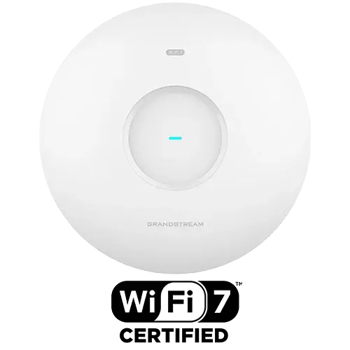
More connected devices, higher bandwidth demands, and crowded wireless environments are putting greater pressure on SMB networks. Grandstream’s GWN7670E Wi-Fi 7 access point addresses those challenges with support for up to 512 clients, 3.6 Gbps of aggregate wireless throughput, extended 5 GHz coverage, and flexible deployment and management options.
In this article, we look beyond the Wi-Fi 7 label to examine what makes the GWN7670E an attractive choice for medium-scale, high-density wireless environments.
GWN7670E highlights and Wi-Fi 7 performance
The GWN7670E combines key Wi-Fi 7 capabilities with Grandstream-specific enhancements designed for business deployments. Based on the IEEE 802.11be standard, it supports 2.4 GHz 2×2:2 and 5 GHz 3×3:2 MU-MIMO, downlink and uplink OFDMA,* multi-link operation, 4K QAM, multiple resource units, and preamble puncturing.
Together, these technologies improve data rates, make more efficient use of available spectrum, and support better performance in high-density environments. Multi-link operation (MLO) allows compatible clients to use the 2.4 GHz and 5 GHz bands simultaneously, while preamble puncturing and MRU (multiple resource unit) support help the access point use partially congested channels more effectively.
The GWN7670E also builds on the Wi-Fi 7 standard with features intended to simplify installation, improve radio frequency (RF) performance, and support deployments ranging from a single standalone access point to a larger managed wireless network.
*OFDMA stands for orthogonal frequency-division multiple access. It's the technology that allows a Wi-Fi access point to divide a wireless channel into smaller units and assign those units to multiple devices at the same time. For more Wi-Fi terminology and an explanation of how Wi-Fi 7 differs from Wi-Fi 5, Wi-Fi 6, and Wi-Fi 6E, see our previous article.
GWN7670E features that go beyond the Wi-Fi 7 standard
Of course, many of the capabilities described above are part of the broader Wi-Fi 7 standard and are offered by other wireless access points (WAPs) on the market. What makes this device especially interesting, however, is how it builds on that foundation with Grandstream’s product-specific features and implementation choices.
Xtra Range 2.0 technology
Because electromagnetic radiation at different frequencies propagates differently through space, the 5 GHz band typically has a shorter range than the 2.4 GHz band. As a general rule, higher-frequency signals experience greater path loss and are more easily weakened by walls, furniture, and other obstacles than lower-frequency signals. This means that although 5 GHz offers important performance advantages, it is also more sensitive to distance and physical obstructions.
The GWN7670E uses Grandstream’s Xtra Range 2.0 technology to help improve 5 GHz coverage and signal penetration in real-world environments. Using its own antenna design, radio tuning, and firmware optimizations, this technology delivers enhanced 5 GHz coverage compared with ordinary designs. The result is improved signal penetration through obstacles, expanded reach, and increasing stability.
PPSK accounts
For installations in small businesses that don’t have their own authentication servers for user authentication (i.e., RADIUS), the WAP itself can support up to 1000 private pre-shared key (PPSK) accounts. This enables each user to have their own credentials to log into the wireless network, improving access control, enhancing security, and providing a more personalized experience for end users.
Highly customizable captive portals
Flexible captive portals enable businesses to streamline access verification while boosting brand awareness through targeted marketing messages. Captive portal options include RADIUS, social login (leveraging Facebook and Google credentials), vouchers, and Active Directory authentication.
Flexible installation options
Each installation scenario is different, as is the infrastructure of the buildings and facilities in which wireless networks are deployed. To facilitate installation, the device includes a multipattern bracket suitable for mounting on walls or ceilings and for attaching to standardized drop ceilings and junction boxes. The bracket is compatible with eight scenarios, including a standard T-Bar ceiling mount, several standardized junction box sizes, and single- and double-gang outlet boxes.
Multiple management options
Grandstream makes wireless AP management a breeze with a range of options. These include:
- A local embedded controller that can manage up to 50 local GWN APs
- GDMS Networking: A free cloud management platform for unlimited GWN APs
- GWN Manager: A premises-based software controller for up to 3,000 GWN APs
- GWN App: Integrates GDMS Networking and GWN Manager to manage GWN APs via the app
With these options, virtually all use cases are covered, from small cost-sensitive single-AP deployments to large multi-building campus installations.
Understanding the BE3600 designation
The GWN7670E WAP is marketed as a BE3600 access point. This term indicates that the access point is based on IEEE 802.11be, which is where the “BE” comes from. This is the official IEEE standard behind Wi-Fi 7. It also indicates that the total aggregate wireless bandwidth it can support is 3600 Mbps, or 3.6 Gbps.
This does not mean that each user will get 3.6 Gbps of throughput. Rather, it refers to the combined theoretical maximum data rate across the access point’s wireless radios. It is an aggregate wireless throughput figure for the device. Specifically, it refers to the sum of the 688 Mbps offered by the device’s 2.4 GHz radio and the 2,882 Mbps supported by the 5 GHz radio, for a total of 3,570 Mbps or about 3.6 Gbps.
Deployment considerations
The published performance figures in data sheets should be understood as general guidelines derived from theoretical maximum values that are rarely reached, if ever. The 3.6 Gbps aggregate bandwidth and the 575’ (175 m) coverage area should be viewed as “up to” values and depend heavily on many parameters of the installation environment.
Also note that the GWN7670E is a dual-band Wi-Fi 7 WAP and does not support the 6 GHz band, which is more than sufficient for most SMBs. However, organizations specifically looking for tri-band Wi-Fi 7 should take this into account and consider alternatives like the Grandstream GWN7672.
Key features of the GWN7670E
Some of the most noteworthy features of this device include the following:
- Wi-Fi 7 certification
- 3.6 Gbps aggregate wireless throughput
- 2.5 Gbps wired throughput
- Xtra Range 2.0 technology extending the 5 GHz band range
- Unobstructed coverage reaches up to 575 feet (175 m)
- Up to 512 simultaneously connected clients
- Advanced QoS features for sensitive applications
- One 2.5 Gigabit Ethernet RJ45 port supporting IEEE 802.3at PoE
- Built-in security features, including WPA3, secure boot, certificate-based protection, and random default passwords
- Multiple management scenarios, including local management, GDMS, and GWN Manager
Browse our online catalog for Grandstream Wi-Fi access points.
Conclusion
As a Wi-Fi 7-certified device, the GWN7670E brings many of the advantages of this advanced standard into a practical, SMB-friendly access point. It offers exceptional aggregate wireless performance, dual-band operation, Xtra Range 2.0 technology, flexible captive portal options, PPSK support, and multiple management choices. All of these features make it an attractive choice for medium-scale, high-density environments that need reliable wireless performance without unnecessary deployment complexity.
While not a tri-band 6 GHz access point, it offers a strong balance of performance, coverage, manageability, and cost-effectiveness for many business wireless deployments.
You may also like:
How to design Wi-Fi 6 & 7 for high-density voice
Slow Wi-Fi at remote branches? Grandstream GWN7062 routers fix that
Grandstream expands its Wi-Fi 7 AP lineup with the GWN7670WM and 7670LR



Comments