






Voice and video communications carry some of an organization’s most sensitive conversations, but the systems that support them are often treated as ordinary network traffic, creating security gaps that attackers may be able to exploit.
Behind the scenes, signaling messages set up and control the session, while separate media streams carry the actual voice or video. If either of these components is left unprotected, attackers may be able to intercept call details, manipulate sessions, or capture media packets that were never meant to be exposed.
That is why securing real-time communications requires attention to both parts of the call path. SIP over Transport Layer Security (TLS) helps protect the signaling messages used to establish and manage the session, while Secure RTP (SRTP) helps protect the media stream that carries the actual conversation. Together, these two technologies provide an important foundation for securing VoIP, UC, and other real-time collaboration services.
In this article, we take a closer look at how SIP over Transport Layer Security (TLS) and Secure RTP (SRTP) work together to protect real-time communications. We’ll examine the difference between signaling and media traffic, what each technology helps secure, and why both are important for protecting VoIP, UC, and collaboration environments.
How real-time communications move across the network
UC and VoIP communications behave differently from conventional data applications on a network. Not only are they more susceptible to phenomena such as jitter, packet loss, and latency, but they also typically consist of two components: the signaling and the actual audiovisual media.
Signaling is handled by protocols like the Session Initiation Protocol (SIP), which allows devices like IP phones, IP PBXs, softphones, voice gateways, and other servers or endpoints to exchange signaling messages. Signaling enables these devices to find each other, negotiate call parameters, establish the session, make changes during the call, and properly terminate the session when the call is complete.
SIP does not carry the actual audiovisual media. This is done by the Real-time Transport Protocol (RTP), an application layer protocol. RTP runs on top of the User Datagram Protocol (UDP), a transport layer (layer 4) protocol typically used for real-time media.
All of this means that communication between two SIP endpoints may involve multiple signaling sessions and media flows. The following diagram illustrates this more clearly.
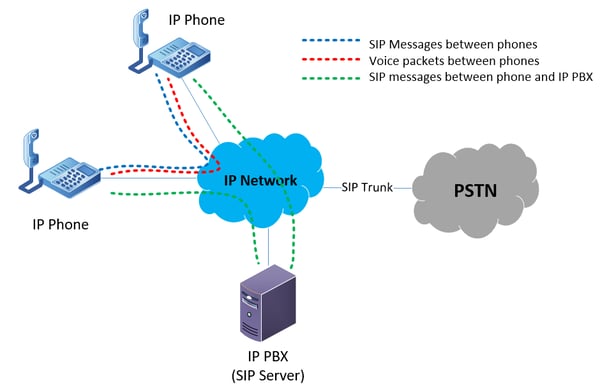
During a voice call between two IP phones, a SIP session is initiated while a separate RTP flow carries the voice packets. In many IP PBX environments, SIP signaling is exchanged between each IP phone and the IP PBX to enable more complex call control features.
During the call, the RTP flow carries the actual media, while the SIP dialog remains in place so that the endpoints or call-control systems can modify or terminate the session when needed.
Why SIP and RTP need additional protection
UC and VoIP communications depend on the architecture described above to successfully complete communications sessions. However, this arrangement has inherent security vulnerabilities. Both SIP and RTP lack built-in security features to protect against malicious users hijacking these communications.
If SIP signaling is exposed or manipulated, an attacker may be able to gain access to sensitive call information, interfere with call setup and control, impersonate endpoints, redirect calls, contribute to toll fraud, or disrupt legitimate communications. If the flow of RTP packets is compromised, an attacker may accumulate transmitted packets and reconstruct voice conversations, making it possible to essentially eavesdrop on what the participants consider a private channel.
What unprotected SIP signaling can potentially reveal
SIP signaling contains valuable metadata necessary for the operation of real-time communications. This includes the caller and called numbers, SIP usernames and domains, IP addresses of vital infrastructure (including IP phones, PBXs, SBCs, or trunks), call routing information, codec negotiation, and potential authentication exchanges depending on the design. Below is a packet capture of a SIP INVITE message. Within it, you can see information such as the caller ID and source and destination SIP devices.
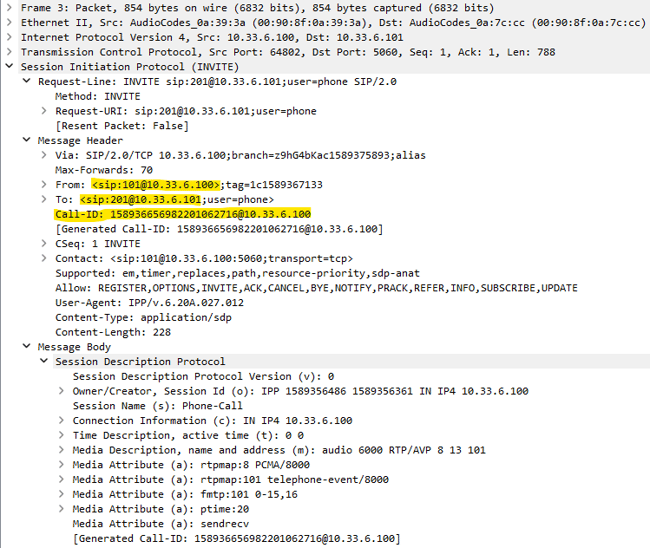
Even if the actual audio of a conversation is not captured, signaling can reveal useful information to an attacker that can potentially become as serious as eavesdropping on a conversation.
Protecting both signaling and media
This is where SIP over TLS and SRTP come in. These technologies help mitigate the attacks described above by applying security features to both signaling and media traffic. Let’s take a closer look at each one.
SIP over TLS
SIP over TLS is a framework for securing SIP signaling messages. It uses Transport Layer Security, a protocol that encrypts and protects communication between devices over a network. Specifically, TLS provides:
- Encryption: Others cannot easily read the data being exchanged, even if it is intercepted.
- Integrity: It ensures that data cannot be changed in transit without detection.
- Authentication: It allows one side, usually the server or endpoint, to prove its identity using a certificate.
SIP over TLS is similar in concept to HTTPS. Just as HTTPS protects HTTP by running it over TLS, SIP over TLS protects SIP signaling by encrypting and securing the SIP messages exchanged between devices.
Secure RTP
Securing SIP is just half the task. The RTP session must also be secured, and that’s where SRTP comes in. SRTP encrypts the media stream and provides integrity and replay protection so that captured voice packets cannot be easily listened to, modified, or reused by an attacker.
As with SIP over TLS, encryption helps prevent intercepted traffic from being understood by unauthorized parties. SRTP also adds an authentication tag to verify that the packet originated from the expected sender and was not modified in transit. Packet sequence information is used by SRTP to help detect and reject replayed packets. This helps prevent an attacker from capturing old media packets and injecting them into the stream.
SRTP encrypts the RTP media payload, but it typically does not handle key exchange on its own. The encryption keys and related parameters are negotiated or exchanged through another mechanism, typically via SIP signaling itself. Each VoIP or UC application will apply this in its own manner.
Planning for compatibility and certificate issues
Although SIP over TLS and SRTP are important components of a secure communications environment, their introduction can introduce complexity and operational challenges that must be addressed.
SIP over TLS depends heavily on proper certificate management. Phones and PBXs must trust the certificate authority that issued the certificate, and the certificate name should match the fully qualified domain name (FQDN) used by the endpoint. Expired certificates, mismatched names, missing intermediate certificates, or devices that do not trust the issuing certification authority (CA) can cause phones to fail registration or SIP trunks to go down. For this reason, certificate renewal and monitoring should be part of the voice security plan.
Compatibility is another potential complicating issue that must be addressed appropriately. Some endpoints, such as IP phones, ATAs, paging systems, door phones, and devices like voice gateways or legacy PBX platforms, may not support SIP over TLS or SRTP, or they may support only specific versions. In many systems, SRTP can be configured as optional, preferred, or required. If encryption is required but one endpoint does not support it, the call may fail.
It is also important to understand what portions of a communication are encrypted and which remain unprotected. In many UC and VoIP environments, end-to-end encryption is required between users. A phone may use SIP over TLS and SRTP to the PBX, while the PBX or SBC terminates that encrypted session and establishes another call leg toward a SIP provider, contact center platform, recording system, or PSTN gateway. Each segment of the call path must therefore be evaluated separately to ensure a fully protected communication environment.
Why protocol knowledge still matters
In the past, network engineers were much “closer” to these protocols because the platforms that used them required detailed configuration. Modern UC and VoIP platforms often hide much of this complexity behind web interfaces and simple configuration options. In many systems, enabling TLS or SRTP may be as simple as selecting a checkbox or choosing a security profile.
This abstraction is useful because it makes secure configuration more accessible, but it can also create a knowledge gap. Engineers may enable encryption without fully understanding what is being protected, what remains exposed, where encryption begins and ends, how keys are exchanged, or why certificate validation matters. For that reason, it is still important to understand the protocols underneath the interface.
Conclusion
SIP over TLS and SRTP should not be viewed in isolation but rather as complementary technologies that are necessary for a complete security solution. SIP over TLS protects the signaling while SRTP protects the media stream that carries the actual voice or video conversation. Knowing what these technologies are, what they do, and how they behave helps network engineers better understand what is required for a comprehensive security policy for VoIP, UC, and enterprise networks as a whole.
You may also like:
Boost UCaaS quality with smarter SD-WAN strategies
Why to pay attention to telecom & networking equipment certifications
Essential steps for applying QoS on UC networks



Comments