





By Steve Fang, CTO | VP of Product, Vola Networks
As traditional copper-based phone service (also known as the PSTN or POTS) is phased out across the country, tens of thousands of emergency communications devices are at risk of losing their lifeline. Elevator phones, fire alarm panels, burglar alarm systems, gate entry intercoms, and other life-safety devices were built to run on analog lines. And those lines are going away.
For telecom and UC installers and resellers, this situation is both a challenge and a significant opportunity. Vola Networks, a U.S.-based high-quality equipment provider, offers POTS (an acronym for plain old telephone service) replacement solutions tailored specifically for managed service providers (MSPs).
Why the POTS sunset matters for emergency systems
In 2019, the FCC’s POTS Lines Forbearance Order 19-72A1 set the stage for the end of legacy analog telephone service in the United States. Major carriers including AT&T and Verizon have been decommissioning copper infrastructure ever since, and prices for remaining POTS lines have increased dramatically — in some cases by 300 to 500 percent over the past decade. The message to the market is clear: get off analog lines now, or pay a steep premium for a service that may not last.
Most organizations have already migrated their general telephony to VoIP or cloud-based platforms without too much difficulty. But, don't forget the devices that still depend on an analog dial tone. These include:
- Elevator emergency phones, which are required by code to connect passengers to a 24/7 monitoring center
- Fire alarm panels, which use analog phone lines to report alerts to central monitoring stations
- Burglar and intrusion alarm systems
- Entry gate intercoms and access control systems
- Fax machines and point-of-sale terminals in regulated industries
Simply plugging a standard VoIP adapter into any of these devices won't work. Each application has specific signaling requirements, power dependencies, and regulatory obligations that generic VoIP solutions cannot meet. That's where purpose-built POTS replacement solutions like those from Vola Networks come in.
Why standard VoIP is not enough for emergency applications
Emergency communications systems present a unique set of technical challenges that differentiate them from ordinary telephone service.
Power independence is the first issue. Traditional copper phone lines carry their own electrical power from the central office, which is why an old landline phone still works during a power outage. A standard VoIP terminal has no such capability. For elevator emergency phones and fire alarm panels, the ability to operate during a building power failure is not optional — it is a code requirement.
Signal integrity is the second issue. Fire alarm panels typically communicate with central monitoring stations using Contact ID, a DTMF-based protocol that is extremely sensitive to timing variations and signal distortion. When analog signals are converted to digital packets over a standard VoIP connection, even minimal packet loss or jitter can corrupt the DTMF tones, causing the alarm signal to go unrecognized at the monitoring station.
Location identification is a third consideration. POTS lines provide automatic location information to emergency responders. When switching to VoIP, additional configuration on the cloud PBX is required to ensure accurate caller location data is transmitted.
Finally, regulatory compliance governs both elevator phones and fire alarm systems. Elevator emergency communication must meet ASME A17.1 code and ADA accessibility requirements. Fire alarm reporting must comply with NFPA 72. Any replacement solution must satisfy these standards, which means installers cannot take shortcuts.
Purpose-built hardware for critical POTS replacement
Vola Networks has spent more than a decade developing hardware specifically for the POTS replacement market. Unlike generic ATA gateways, every product in Vola’s lineup is engineered for the demands of life-safety and M2M (machine-to-machine) applications, with built-in battery backup, cellular redundancy, and protocol support for Contact ID, fax, and modem communications.
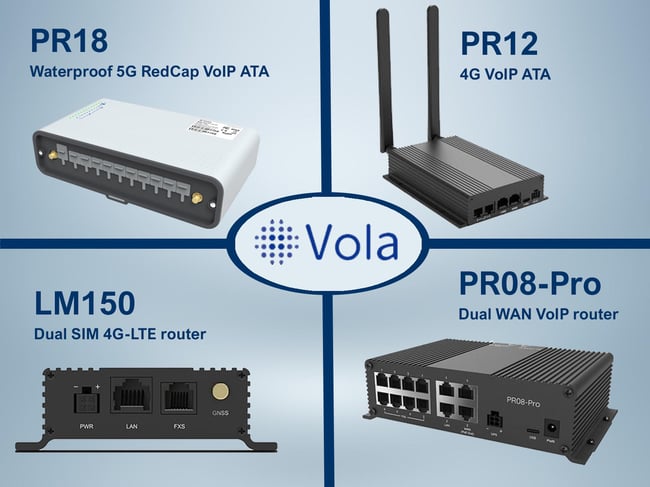
The flagship product for multi-line commercial POTS replacement deployments is the PR18, a high-density 5G RedCap communications platform designed specifically for mission-critical analog infrastructure. Featuring eight FXS ports, dual Gigabit Ethernet interfaces, dual SIM support, integrated battery backup, and an IP65-rated industrial enclosure, the PR18 is built to support elevator emergency phones, fire alarm panels, fax machines, security systems, and other legacy analog devices without requiring modifications to the connected equipment.
By converting traditional analog signaling into secure IP and cellular communications, the PR18 enables organizations to modernize infrastructure while preserving compatibility with existing field devices. Its 24-hour standby capability, WAN failover support, PoE functionality, and rugged outdoor-ready design make it ideal for large commercial buildings, utility infrastructure, transportation systems, and distributed multi-site deployments where reliability and resilience are critical.
For smaller or more compact installations, the PR12 is an all-in-one 4G LTE ATA with two FXS ports and a built-in battery. It supports both VoIP and VoLTE, includes dual SIM slots for carrier redundancy, and is particularly well-suited for elevator emergency phones and life-safety applications in locations where broadband connectivity may be unavailable or unreliable.
For single-line deployments, the LM150 is an industrial-grade VoLTE modem certified by the FCC, PTCRB, and AT&T. With dual SIM support and PoE capability, it provides a simple plug-and-play replacement for a single POTS line, ideal for remote monitoring systems, small buildings, and standalone emergency communication endpoints.
For flexible indoor commercial deployments requiring multi-line analog support, the PR08-Pro dual-WAN VoIP router remains an effective solution, offering dual-WAN connectivity, eight FXS ports, integrated battery backup, and centralized management compatibility for a wide range of legacy voice applications.
A closer look at Contact ID signaling and how to handle it post-POTS
The Contact ID signaling issue deserves special attention because it can trip up installers who are new to POTS replacement.
When a fire or burglar alarm panel sends a signal to a central monitoring station, it does so using precisely timed DTMF tones. Standard VoIP networks use audio compression codecs that can subtly alter or drop portions of these tones, making them unreadable at the receiving end. The result: the alarm fires, the panel transmits, and the monitoring station receives nothing. That is a life-safety failure.
Vola addresses this with its POTS Media SBC, a session border controller purpose-built for POTS replacement applications. The SBC supports Contact ID (both transmit and relay modes), V.150.1 modem relay, and T.38 fax. It applies advanced jitter buffering, error correction, and signal recovery mechanisms to ensure that DTMF-based protocols arrive intact at the monitoring station, even over imperfect IP networks. For MSPs and service providers building a POTS replacement practice, the Vola SBC can integrate with existing UC cloud platforms including Broadsoft, Metaswitch, and Crexendo.
Manage it all with VolaCloud
POTS replacement does not end at installation. Once emergency phones, alarm panels and other analog endpoints are connected to modern networks, they still need to be monitored, maintained and supported. For installers and managed service providers, remote visibility can make the difference between proactive service and costly truck rolls.
Vola’s answer is VolaCloud, a cloud-based device management platform built on the TR-069 protocol with REST API support for integration into existing MSP business systems. Through VolaCloud, technicians can monitor real-time device status, signal strength, battery health, SIM data usage, and FXS line activity across an entire fleet of deployed devices from a single dashboard. Remote configuration, firmware updates, and power cycling are all available without a site visit. 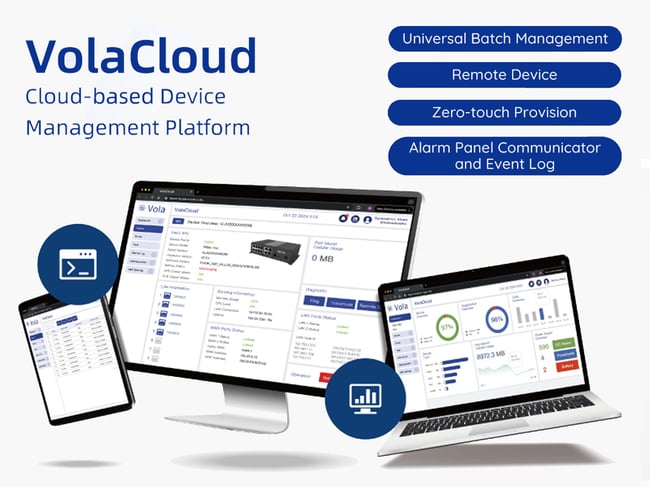
The opportunity for installers and resellers
Every commercial building with an elevator has a POTS replacement problem. Every property with a monitored fire alarm system has a POTS replacement problem. Hospitals, schools, apartment complexes, office parks, hotels ... the list of affected sites is enormous.
For telecom and UC professionals, POTS replacement for life-safety applications is a differentiated service with real barriers to entry. It requires knowledge of analog signaling protocols, regulatory compliance requirements, power backup engineering, and carrier-grade reliability standards. That expertise has value, and customers who need their elevator phones and alarm panels to work are willing to pay for it.
Vola Networks operates strictly as a hardware supplier and does not offer end-customer retail POTS services, which means resellers and MSPs can build their own service practices on top of Vola’s hardware without channel conflict. The company supports SIM cards from major U.S. carriers and provides the full stack: CPE hardware, POTS Media SBC, and VolaCloud management.
Conclusion
The sunsetting of POTS is already underway, and the devices most at risk of being overlooked are life-safety systems that can't simply be swapped for a standard VoIP adapter, such as elevator phones, and fire alarm panels. Each application has specific requirements around power backup, signal integrity, and regulatory compliance that generic solutions can't meet.
Purpose-built hardware from Vola Networks addresses these challenges directly, and for installers and resellers already helping customers migrate off POTS, life-safety devices are a natural extension of that work.
Speak with your TeleDynamics rep to learn more about Vola Networks’ POTS replacement solutions for elevator phones, alarm systems, and other emergency applications. To explore TeleDynamics’ full catalog of VoIP gateways, ATAs, and networking equipment that complement a complete POTS replacement practice, visit teledynamics.com.
You may also like:
Accelerate your migration from TDM to IP telephony with Yeastar
How to prepare your network for the demands of AI
The rise of CPaaS (communications platform as a service)



Comments