Daniel Noworatzky
Chief Technology Officer, TeleDynamics
Voice over IP networks can be challenging to implement efficiently and securely. This is in part because voice packets require specialized management and must be treated differently than normal data packets. Quality of Service (QoS), security and flow control are just some areas in which the required handling of voice traffic differs from conventional data traffic.
The good thing is that with the proper expertise and care, many of these issues can be successfully dealt with within the corporate network. Such networks are under the complete control of the network administration team and thus can be fully customized for the needs of the voice being transmitted.
However, what happens when voice packets are routed beyond the corporate network, either for voice calls to the PSTN or mobile network, or for employees who use internal voice network services remotely? Here we look at various network edge mechanisms that can be used to monitor and manage data traveling in and out of the LAN.
Read More
Topics:
QoS,
VoIP,
Total Voice Solution,
Trends,
Network Security,
Network Design
When most people hear about VoIP, they think of telephony over the internet. Online services that offer extremely-low-cost phone calls or even free calls may come to mind. Although such services do utilize VoIP (voice over internet protocol), IP telephony in a broader sense is technology and architecture that uses VoIP to allow you to create an internal telephone network within your organization that leverages the existing data network infrastructure.
IP telephony operates on converged network, which supports both voice and data. The advantages of this to a business are numerous and are well worth the investment. If you are considering a migration to IP telephony, here we present some information that can help get you on track.
Read More
Topics:
Business Telephone System,
VoIP,
SIP,
Trends,
Productivity
Product review
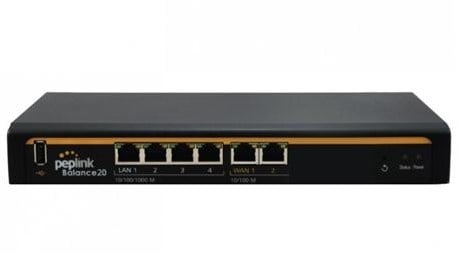
There are several ISPs (internet service providers) that can provide your business with high- and super-high speed internet access. These technologies include Metro Ethernet and Fiber to the Premises (FTTP) and offer speeds from several Mbps to 1 Gbps and beyond – but with a hefty price tag.
An alternative is the bonding of multiple ADSL/VDSL or cable lines to take advantage of the aggregate bandwidth of these connections while paying a comparably miniscule monthly cost. All that’s needed is a load balancing WAN router like Peplink’s Pepwave Balance 20 Dual-WAN Router.
Designed for small office and branch office use, not only does the Balance 20 router perform link bonding and load balancing, but it also offers an impressive array of additional features.
Read More
Topics:
Business Continuity,
Routers
As one of the biggest expenses of any business, telecommunications solutions should be both reliable and cost-effective. One telephony network design aspect that can provide both is the direct connection of the IP phone system to a mobile network.
Here we explore two ways to do this, either of which not only achieves cost savings for the company but also enhances reliability by providing an additional redundant and overflow route.
Read More
Topics:
Business Telephone System,
VoIP,
SIP,
Total Voice Solution,
Business Continuity,
Mobile
If you deal with Voice over IP (VoIP), you must have come across this scenario at one time or another: A user complains that when they answer their phone, the caller can’t hear them, even though they can hear the calling party. Or, it may be that neither party can hear the other and there is just silence on the line.
This is the classic case of one-way or no-way audio, where a voice call is successfully completed, but either the voice packets only successfully travel in one direction, or neither end successfully receives voice packets. It may be difficult to understand why this happens, especially since the phone does ring, both physically for the called party and via the ring-back tone for the calling party. It seems counterintuitive that the transmission of voice packets could be unsuccessful if the call was successfully set up.
This is a scenario that comes up a lot on our tech support calls at TeleDynamics. Here we list four of the most common culprits of this issue and suggestions for how to tackle them.
Read More
Topics:
SIP Phones,
QoS,
VoIP,
SIP,
Troubleshooting
Grandstream and Ubiquiti add excitement to desk phones by leveraging the power of Android OS and a modern interface. By integrating the Android Operating System into the phone, thousands of business productivity applications like Skype, GoToMeeting, Gmail and more can be downloaded onto these phones from the Google Play store.
Advanced apps ranging from Pomodoro Technique Timer to more obvious solutions provided by Google Calendar will make workers in any industry more productive as they perform phone call campaigns and meetings with one device instead of two. The versatility that the Android platform provides is a huge differentiator that separates these phones from a typical IP phone.
Here we look at five SIP endpoints from Grandstream and Ubiquiti that use Android OS.
Read More
Topics:
SIP Phones,
Business Telephone System,
VoIP,
SIP,
Grandstream,
Android,
Productivity
About 90% of businesses in the United States have fewer than 20 employees, according to the Small Business & Entrepreneurship Council. In the past, companies of this size often couldn’t benefit from PBX functionality like IVR (interactive voice response), hunt groups, hold music, and so forth, because of the high cost of installing and maintaining a PBX.
But today, things are different. Thanks to hosted VoIP service, micro-enterprises can have a phone system with even more functionality than a legacy PBX, even if they only have one user! All they need is a broadband Internet connection. With VoIP, micro-businesses can be more efficient and enjoy the same functionality that big corporations have relied on for decades.
Here we look at how a micro-enterprise can get started with VoIP and some of the benefits it can reap as a result.
Read More
Topics:
SIP Phones,
IP PBX,
QoS,
Business Telephone System,
VoIP,
SIP,
Trends,
Mobility (including remote work)
Replacing a legacy PBX that a company has used for years with an IP PBX can be intimidating, and understandably so. That’s why we recommend a transition method that allows the new technology to be gradually introduced over time. This not only ensures business continuity but also gives the associates plenty of time to adjust to the new equipment.
Read More
Topics:
Customer Service,
SIP Phones,
IP PBX,
Business Telephone System,
VoIP,
SIP,
Total Voice Solution,
Business Continuity
As the world moves inexorably towards all-IP, there are still businesses today that use a TDM (time division multiplexing) PBX-based phone system. Eventually, they will end up switching to an IP PBX when their old equipment becomes unserviceable or irreplaceable, but for whatever reason they have chosen not to migrate yet. Even so, there are ways to help these companies reap some advantages from VoIP technology while hanging onto their legacy system.
Read More
Topics:
Business Telephone System,
VoIP,
SIP
Fashion models aren’t the only ones who accessorize. Your customers need accessories, too! If they have an IP phone system, peripherals are an easy way to instantly boost productivity. When putting together your next enterprise telephone system proposal, consider including some from this list, or browse our website for more ideas.
Read More
Topics:
Customer Service,
SIP Phones,
Wireless,
Business Telephone System,
VoIP,
SIP,
Peripherals,
Mobility (including remote work),
Headsets,
Conferencing