Daniel Noworatzky
Chief Technology Officer, TeleDynamics
Given the increasing mobility of the global work force, enabling users to interact with your VoIP endpoints via a web or mobile app interface will arguably be one of the most significant integrations that will be leveraged for business telephony systems in 2021. In this article, we examine how and why to integrate your VoIP system with WebRTC.
Read More
Topics:
VoIP,
Grandstream,
Software Integration,
Trends,
Mobility (including remote work),
Productivity,
Cloud,
Yeastar
Product Review
In today’s world, businesses have to pivot on a moment’s notice in order to survive. They need communications systems that are scalable and flexible enough to handle a mix of onsite and remote workers, as well as be used with a variety of enterprise and employee-owned devices, not to mention enhanced security to enable users to connect to the network in a variety of ways. Grandstream’s UCM6300 ecosystem is up to the task.
In this article we examine Grandstream’s UCM solutions that help companies adapt and thrive in a changing landscape.
Read More
Topics:
Business Telephone System,
Total Voice Solution,
Grandstream,
Trends,
Mobility (including remote work),
Product Review,
Cloud,
Unified Communications
Product Review
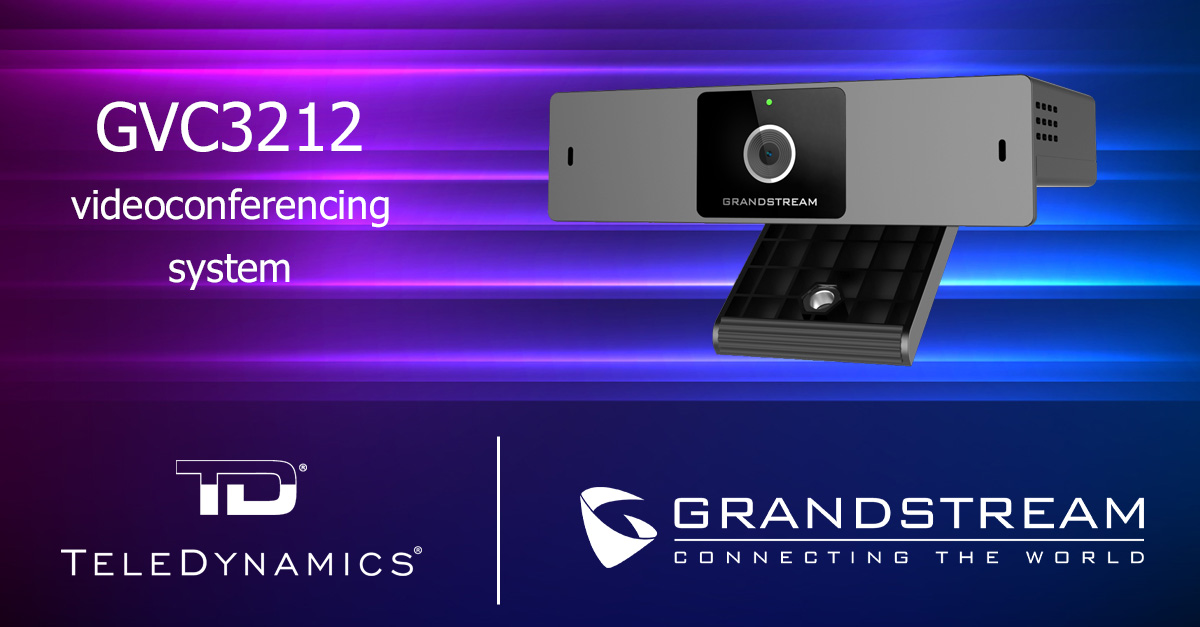
The GVC3212 HD video conferencing endpoint is the newest addition to Grandstream’s GVC32xx series of videoconferencing systems. Built with today’s communications needs in mind, the GVC3212 is a compact and affordable solution for remote workers and small conference rooms. Keep reading to learn more about what makes this device particularly useful for working from just about anywhere.
Read More
Topics:
Grandstream,
Videoconferencing,
Product Review
The North American Numbering Plan (NANP), which is the numbering plan used in the United States, Canada, Puerto Rico and certain other locations, can sometimes present unusual limitations on phone number moves, adds or changes, and on certain operations of your telephony network. In this article, we provide a quick overview of these to help you ensure compliance when it comes to caller ID configurations, number portability, and more.
Read More
Topics:
Business Telephone System,
Regulations
The benefits that voice over IP (VoIP) provides for the communications needs of all types of organizations are almost endless, including mobility, flexibility, economy, and interoperability. One advantage that is key to the future of the technology is its ability to be easily integrated with many different software platforms using what are known as application programming interfaces (APIs).
In this article, we examine why VoIP integrations are so important and what they mean for communications, both today and in the future.
Read More
Topics:
VoIP,
Yealink,
Software Integration,
Trends,
Productivity,
Unified Communications
Within the context of a global pandemic and the uncertainty that comes with it, even the most basic necessity of receiving medical attention when you need it is not that straightforward anymore. New and innovative technologies are needed to ensure that everyone has access to medical services.
Read More
Topics:
Peripherals,
Trends,
Mobility (including remote work),
Videoconferencing,
Product Review,
Unified Communications,
Konftel
There’s a lot more to music on hold (MoH) than you may think. Using it to your fullest advantage can go a long way towards improving your customer’s experience with your company. In this article we take a look at how MoH works and offer some tips on how you can maximize its benefit for your business.
Read More
Topics:
Customer Service,
VoIP,
Total Voice Solution,
Software Integration,
Business Strategy,
Unified Communications
While certain live events have been cancelled amidst the COVID-19 pandemic, many of them have been replaced with virtual counterparts that have taken place via videoconference. Some of these events have had hundreds or even thousands of participants. With such numbers, how do videoconferencing systems cope with the traffic load and processing power required?
In this article, we take a look at the concepts involved with the scaling of videoconferencing for large numbers of participants. We also examine some best practices to keep in mind that will help ensure the quality of the end user experience.
Read More
Topics:
Total Voice Solution,
Yealink,
Videoconferencing,
Network Design
Much experience has been gained over the past year when it comes to distance education and learning. The systems required to enable it have quickly developed and have been extensively streamlined. One of the most successful vendors in this process has been Konftel with its award-winning video-capable conference phones.
Read More
Topics:
Trends,
Mobility (including remote work),
Videoconferencing,
Unified Communications,
Konftel
With its new T3 series IP phones, Yealink continues its tradition of providing advanced yet cost-effective enterprise telephony solutions to businesses of all sizes. Packed with a plethora of features, these entry-level phones can satisfy both the voice network administrator and the budget coordinator of most organizations. Read on to find out more about what they have to offer.
Read More
Topics:
SIP Phones,
Business Telephone System,
Yealink,
Product Review